

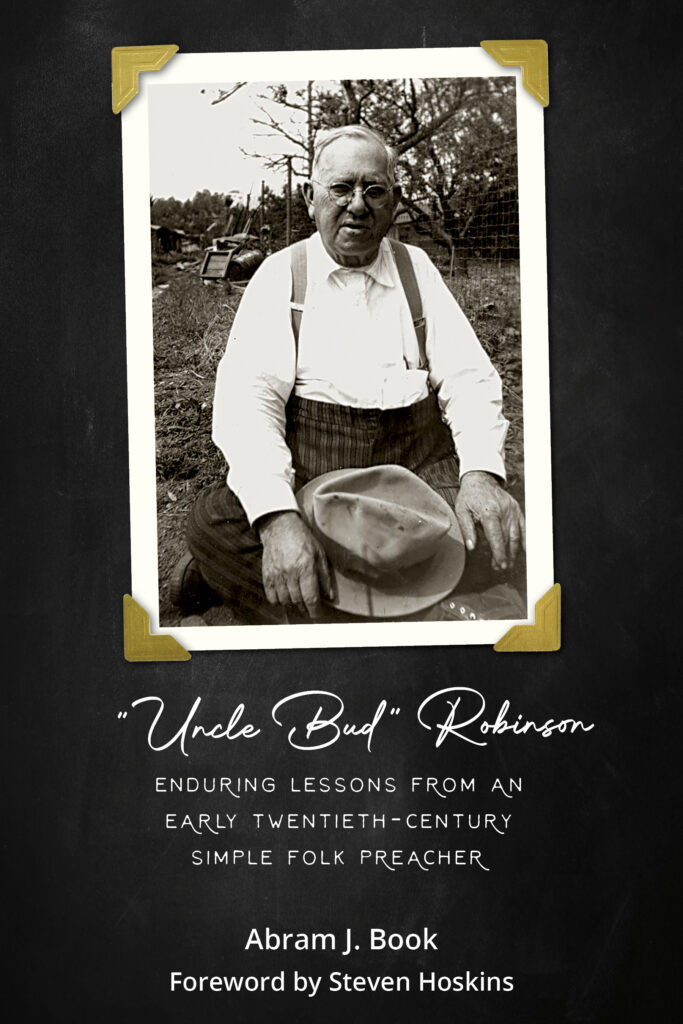
“Uncle Bud” Robinson: Enduring Lessons from an Early Twentieth-Century Simple Folk Preacher
Reuben “Uncle Bud” Robinson, born a moonshiner’s son in Tennessee and converted under the preaching of a traveling circuit rider while working as a Texas ranch hand, persevered to become the Mark Twain of the early twentieth-century holiness movement. And, at the height of his ministry, he was dubbed “the most popular man in America.” This book explains how a man who originally came from nothing eventually came to personify an entire subset of American Christianity and what it means for Christianity and evangelicalism today. The author examines how “Uncle Bud’s” preaching brought together people from all walks of life—wealthy and poor, educated and uneducated, urban and rural—under the banner of holiness and how such communication can be instructive to pastors and Christians today struggling to find unifying messages in a deeply divided religious and political landscape.
Between approximately 1900–1942, Reuben “Uncle Bud” Robinson traveled more than two million miles as an itinerant evangelist, preached more than 30,000 times in that span, sold thousands of copies of the Herald of Holiness, and won more than 100,000 converts to the Kingdom of God and to the holiness movement. Bud accomplished all of this despite an upbringing in the depths of poverty in Civil War Tennessee, illiteracy until the age of 20, being afflicted with a severe stammer, and suffering from epileptic seizures for almost the entire first half of his life. The man born to an abusive alcoholic moonshiner and a spiritual yet sometimes pious mother eventually persevered to become arguably the greatest preacher of the early twentieth century American holiness movement. His simple, folksy preaching style and humorous use of Southern idiom won him admirers around the world. Uncle Bud tirelessly brought the message of holiness to adherents of more than seventy denominations, although he officially identified with the fledgling Church of the Nazarene and was instrumental to the denomination in its early years. Uncle Bud produced a weekly column in the Herald of Holiness and published numerous books and pamphlets, dictating his words to be written down by his faithful wife, Sallie, a schoolteacher. From his encounter with notorious South Carolina badman Baxter “Cyclone Mack” McClendon, to a fistfight with hecklers who attacked him following a revival sermon, to his miraculous recovery from injuries received after he was hit by a car in San Francisco, Bud’s is an action-packed story of God’s grace. More importantly, the life and ministry of Uncle Bud Robinson is important history that carries with it important lessons in theology, communication, resilience, meaning creation, and more.
Endorsements
"This work illuminates the Holiness movement and one of its most important rhetorical leaders, Uncle Bud Robinson. Abram Book's research into this figure is a great example of communication theory in action and how the discipline can enrich our understanding of denominational traditions. Specifically, Book's discussion of the Coordinated Management of Meaning, or CMM, and its workings within the Holiness movement is one of the clearest explanations I've read throughout my career. I highly recommend."
— Brandon Knight, Assistant Professor of Strategic Communication and Leadership, and Director of Speech and Debate, William Carey University
"The incomparable Bud Robinson, the most remarkable oral communicator of the Holiness Movement, has, until now, not received the attention deserved. Abram Book's thorough and insightful exploration of Robinson as a communicator and folk preacher is an important contribution to the academic study of the Holiness Movement."
— William Kostlevy, Archivist Emeritus, Asbury Theological Seminary
"Sometimes people as colorful and plain-spoken as Uncle Buddy Robinson can be appreciated for their ability to communicate to everyday people but dismissed as simplistic or lacking in depth. Abram Book's thoughtful treatment of Uncle Buddy's life and preaching reveals the depth, influence, and genius at work in his ministry. Those who not only want to know about this important past figure but also want to know how to communicate the truths of the Gospel in relevant ways will deeply value this text."
— T. Scott Daniels, General Superintendent, Church of the Nazarene
"Abram Book has provided an insightful analysis of the rhetorical style of one of the Nazarene tradition's most influential ministers. Through this examination we come to understand the impact of Bud Robinson's rhetorical action not only in the denominational sense but in his approach to cultural impact. For those who study religious rhetoric and the revivalist movements of the American 20th century, this is a book that will provide another layer to this unique time in American religious history and the implications for today."
— Joy Qualls, Professor and Associate Dean, School of Fine Arts and Communication, Biola University
"A brilliant analysis of the powerful rhetoric of holiness evangelist Bud Robinson that illuminates both the inner and social spiritual lives of Robinson and his listeners. A long overdue critical and sympathetic study of this master communicator."
— John Lawrence Brasher, Denson N. Franklin Professor of Religion Emeritus, Birmingham-Southern College
"In Uncle Bud Robinson, Abram Book details the life and ministry of the great holiness preacher as a means of exploring Uncle Bud's unique rhetoric — an approach to preaching that allowed him to communicate complex theological concepts to the ordinary folk of his era. Today's pastors, charged with preaching the message of holiness in an increasingly complicated world, can learn much from Uncle Bud."
— Jason Hill, Senior Pastor, Cape Church of the Nazarene, Cape Girardeau, Missouri
"I am not a Nazarene, but I know many Nazarenes and have always wondered about the obvious affection they hold for 'Uncle Bud' Robinson and the story behind Robinson's centrality to Nazarene identity. Abram Book has produced a fine book which explains who Uncle Bud is, why he is important, and how he became so well-known and so fruitful for the Lord."
— Jennifer Woodruff Tait, Senior Editor, Christian History
"Dr. Abram Book brings to life the inspirational story of 'Uncle Bud' Robinson, the Church of the Nazarene's most cherished evangelist. Dr. Book gives us the wisdom of the classics in Aristotle and Cicero alongside the powerful rhetoric—and the good-humored tenderness—of 'Uncle Buddy' himself. Weaving together communication theory, historical analysis, and heart-felt contemporary ministry application, Abram demonstrates Robinson's skill as a communicator and calls for a recovery of Robinson's effective ministry methods."
— Andy Wood, Archivist and Research Historian, Center for the Evangelical United Brethren
"Abram Book's monograph on early twentieth-century Holiness revivalist Bud Robinson offers a roadmap for other Holiness scholars exploring the rhetorical impact of religious culture. Using communication theories like Coordinated Management of Meaning and Burkean rhetorical analysis, Book provides a nuanced look at Robinson's sermons, analyzing news accounts, audio records, and both the written and auditory responses of his audiences. This multi-faceted approach to Robinson's cultural influence provides a testament to the enduring insights of careful, in-depth analysis."
— Christy Mesaros-Winckles, Professor, Communication Arts and Sciences Department, Adrian College
About the author(s)